

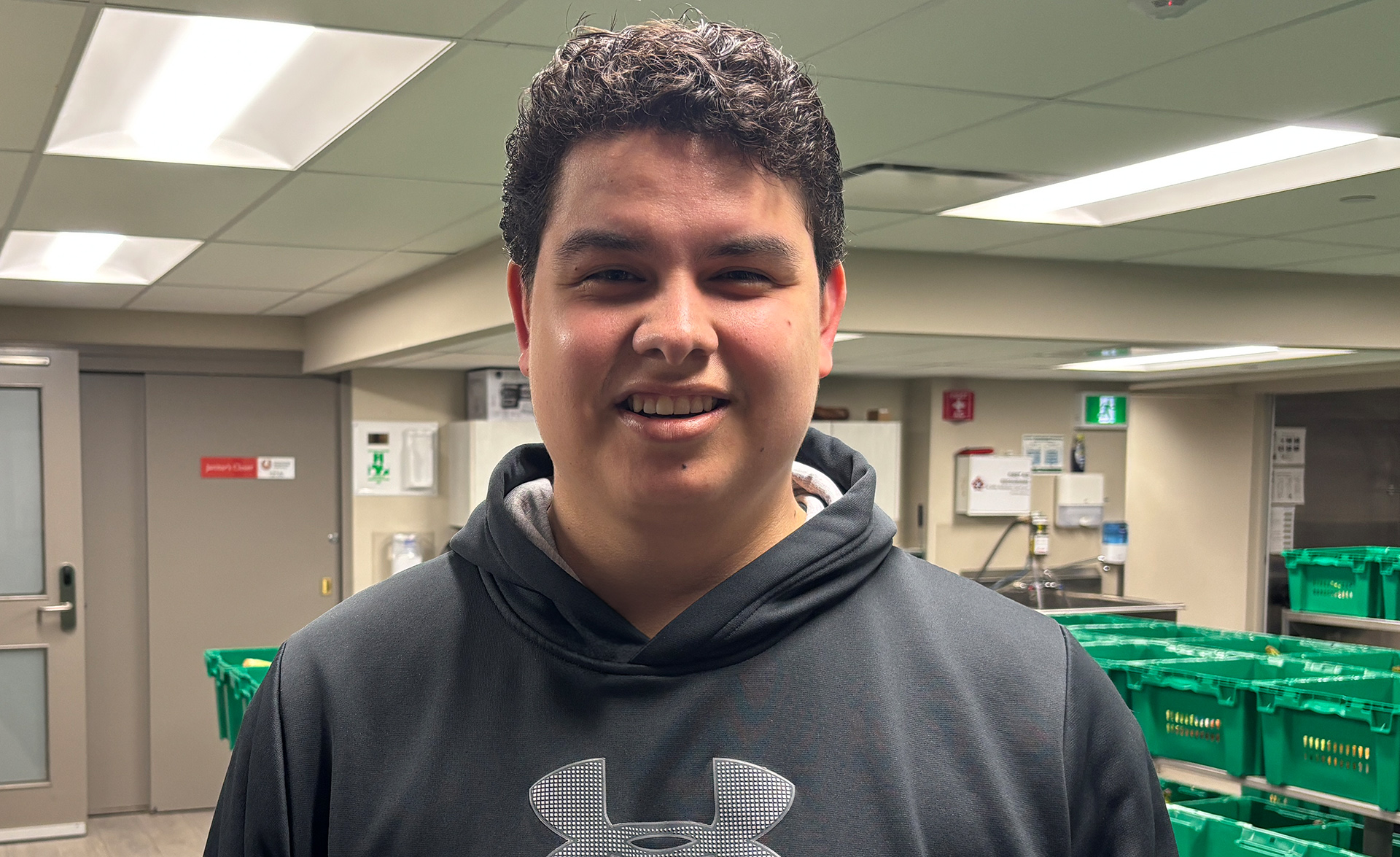
I really enjoy it. I’ve had nothing but positive experiences here.”
More Than a Box: Nicholas’s Approach to Community Health
For Nicholas Keller, a box of fresh produce is about more than what’s inside. It is about access, health and creating stronger connections between people and the resources they need to thrive.
Nicholas is an Ojibwe First Nations medical student at the University of Calgary’s Cumming School of Medicine. For the past year and a half, he has volunteered with the Southwest Ontario Aboriginal Health Access Centre’s Farm Box program in London, helping pack and distribute fresh produce and traditional Indigenous foods to community members.
“For me, when I think about health and healthcare in general, it’s important that it encompasses a holistic approach,” he says.
As a medical student, Nicholas spends much of his time learning about the biomedical side of healthcare. Volunteering with the Farm Box program has reinforced his belief that health is shaped by much more than what happens in a doctor’s office. Access to nutritious food is part of that picture.
“Often times that is emphasized by primary care providers, there is a lifestyle intervention such as diet, but it’s important to emphasize that there’s accessibility within it as well.”
“The Farm Box program” helps make that access possible by providing fresh produce and traditional Indigenous foods to local Indigenous community members. Last year, the program provided 1,622 Farm Box distributions, reaching nearly 300 families. It also supported 580 emergency food distributions, six budget-friendly cooking classes using food from the Farm Box program and three community meals.
For Nicholas, being part of this work has offered a different kind of education, one that takes place outside the classroom.
“Being able to provide back to the community through this volunteer work has really been fulfilling, as it helps me to really see the importance of these community-based health promotion programs.”
The experience has also influenced how Nicholas thinks about his future. He hopes to become a family physician, and his time volunteering has shown him how community-based support can help people make healthy choices by making them more accessible.
“When I can be a volunteer here and see the type of work that’s being done here, it provides me with a sense of motivation as well to be able to continue providing these lifestyle intervention techniques to future patients I’ll be working with.”
For Nicholas, every box is a meaningful part of a much bigger approach to health. And while he is helping provide food and support to families today, the experience is also shaping the kind of healthcare provider he hopes to become.
“I really enjoy it. I’ve had nothing but positive experiences here.”
Last year, United Way funded programs provided:
- 12,982 good food boxes were distributed to families
- 322,157 meals and 44,083 snacks were served
- 6,143 trips to appointments were provided
- 27,150 people got access to basic needs like toiletries and winter clothing